Hosting Tips
How Much Charcuterie Per Person? The Honest Math.
Every generic "2 ounces per person" article online is wrong for events. Here's the portion math used by caterers who actually build event-scale boards — plus the three mistakes hosts make over and over.
The most useful first question isn't "how many guests?" It's "what role is the board playing in your night?"
Because portion math for charcuterie isn't one number. It's a function of context: time of day, what else is being served, how long guests linger near the board, and whether it's the main event or a warm-up act. A "2 oz per person" rule-of-thumb from a generic food blog will either leave your guests hungry or blow your budget.
So here's how to think about it properly.
The four contexts — and what they mean for your order
Every event I build falls into one of four buckets. Your portion math lives inside the bucket.
1. Light grazing (alongside a full meal)
Think: a cocktail-hour board that precedes a plated dinner. The board is scenery. Nobody is eating a meal here — they're having two or three bites and a glass of wine before being called to their table.
The rule: 1.5–2 oz of meat + cheese combined per person, plus accoutrements (crackers, spreads, fruit, nuts) scaled to that.
For a 50-guest cocktail hour, that's about 5 lb of charcuterie (meat + cheese combined), plus a balanced set of accompaniments. Don't skimp on the accoutrements — they're what photograph.
2. Heavy grazing (stands in for appetizers)
This is the most common use I see. The board replaces tray-passed hors d'oeuvres. Guests graze for 60–90 minutes before dinner, and the spread is meant to feel abundant.
The rule: 3–4 oz of meat + cheese per person, with generous accoutrements.
At 3 oz per person, a 75-guest cocktail hour needs roughly 14 lb of charcuterie. Sounds like a lot. It won't be by the time the photo ops begin.
3. Standalone main (charcuterie is the food)
Increasingly common at Edmonton weddings, summer backyard receptions, and casual corporate events. The board is the meal. There's no second course coming.
The rule: 5–6 oz of meat + cheese per person, plus substantial carbs (breads, crackers, crostini) and multiple hot and cold accompaniments. Think: whipped ricotta, Alberta honey, roasted grapes, marinated olives, fresh figs or stone fruit in season, house-made pickled vegetables, seeded crackers, a selection of artisan breads, dips, cured salmon, soft-boiled eggs if brunch, and so on.
At 5 oz/person for 75 guests you're looking at 23 lb of charcuterie alone. This is why a standalone grazing table is an investment — it needs to actually feed people, and it needs to look abundant three hours in.
4. Late-night or take-home
The "second wind" board that appears at 10 pm when guests are coming back from the dance floor hungry. Smaller, tighter, meat-and-carb-forward.
The rule: 1.5–2.5 oz per person, depending on how far into the night it's deployed. Late-night boards get hit hard and fast.
A simple portion-math reference table
| Context | Per guest (meat + cheese) | 50 guests | 100 guests |
|---|---|---|---|
| Light grazing (pre-dinner) | 1.5–2 oz | 5–6 lb | 10–12 lb |
| Heavy grazing (no dinner) | 3–4 oz | 9–12 lb | 19–25 lb |
| Standalone main | 5–6 oz | 16–19 lb | 31–37 lb |
| Late-night | 1.5–2.5 oz | 5–8 lb | 10–16 lb |
Accoutrements — bread, crackers, fruit, nuts, preserves, pickles — add weight and volume but don't count in the meat-plus-cheese figure. A good spread runs the accompaniments at roughly 1.5–2× the protein weight for full boards.
The three mistakes I see hosts make
Mistake 1: Treating cocktail-hour portions as dinner portions.
Hosts see "2 oz per person" online, Google calls it cocktail-hour math, and then order 2 oz per person for an event where the board is replacing dinner. Three hours in, the board looks like the aftermath of a grocery store checkout lane. The night never recovers.
Fix: match portion to role, not to guest count. If your board is standing in for a meal, feed people like it's a meal.
Mistake 2: Over-indexing on meat, under-indexing on accoutrements.
A board of just cheese and prosciutto is not a grazing experience — it's a pile. What makes a charcuterie station memorable is the ratio: the moment your guest reaches a slice of aged cheddar and realizes it wants a dab of fig jam, a sliver of crisp apple, and a walnut half on a rye crisp. That's not accident. That's sourcing.
Fix: for every pound of protein-plus-cheese, budget for 1.5–2 lb of complementary items. Fruits, preserves, pickled things, bread, crackers, nuts, honeys, dips, something warm, something bright.
Mistake 3: Forgetting what the photographer will capture at minute 90.
The first twenty minutes of any grazing station are stunning because the chef styled it that way. The 90-minute photo is the one that matters — because that's when your cocktail-hour photos are being taken by your wedding or event photographer. If the board looks ransacked by then, your Instagram grid will say so forever.
Fix: over-order by 15–20% on the most-photogenic items (whole cheeses, intact bunches of grapes, figs, honeycomb, prosciutto roses). A refill pass at the 60-minute mark keeps the board looking show-ready for the full hour — any attended station worth booking will do this for you.
Edmonton-specific note: climate matters. A board left outside in late July sun in Sherwood Park is a completely different risk than the same board indoors in February. Soft cheeses and cured meats generally have a safe-service window of about 2 hours at room temperature. For outdoor summer events, a caterer should plan fresh-plated refreshes every 60 minutes — same board, new food — so nothing lingers past safe windows.
What you'll typically see per person (rough market bands)
These are ballpark Edmonton-area ranges for grazing-station catering at 2026 rates, meant as a budgeting starting point — not a quote. Actual pricing varies with guest count, venue, season, and how custom the setup is.
- DIY at home: roughly $8–$12 per guest in ingredients alone, before your time. Reasonable for very small gatherings; gets hard to scale past about 25 guests.
- Grab-and-go boxes from a caterer: often $18–$28 per guest, delivered. Good for corporate lunches. Not a centerpiece.
- Styled grazing table (professional): roughly $25–$50 per guest, with variation by region and market tier.
- Full-service station with attended cart: commonly $45–$85 per guest. Includes styling, live service, specialty items, setup, cleanup.
- Multi-station event production: $75–$150+ per guest. Caviar, specialty carving, multiple stations, custom branded elements. For high-end launches and larger weddings.
For an actual number tailored to your event, ask any caterer for a written proposal with everything included.
A short checklist before you book anyone
- Decide the role of the board in your event (cocktail-hour, heavy-graze, main, or late-night).
- Count your guests. Apply the portion math from the table above.
- Add 15% for over-order (for photo-readiness and safety refreshes).
- Ask your caterer what's included in their per-person number — setup, cleanup, attendant, linens, styling, serving pieces, refresh passes? Apples-to-apples pricing only.
- Ask about dietary accommodations. If they don't have a confident answer for gluten-free, vegan, and nut-free, keep looking.
- Ask to see event photos from the 60-minute mark, not just the setup shot.
That last one is my favorite question to hear from a prospective client. Anyone can style a board for an opening shot. The test is what it looks like after guests have been through it.
One last thing
The best portion question isn't "how much?" — it's "how do I make sure my guests remember this?" Portions are table-stakes. What makes a station unforgettable is the particularity: the cheese you've never heard of that turns out to be the favorite of the night, a locally-infused honey, a pepper jelly that ruins every other pepper jelly for you.
That's the part portion math can't solve. That's sourcing. That's where the real work of catering happens.
— Sarah
Planning an Edmonton event?
Tell me about your event — guest count, vibe, timing — and I'll send a custom proposal with portion math, menu, and transparent pricing within 4 business hours.
Start Your Proposal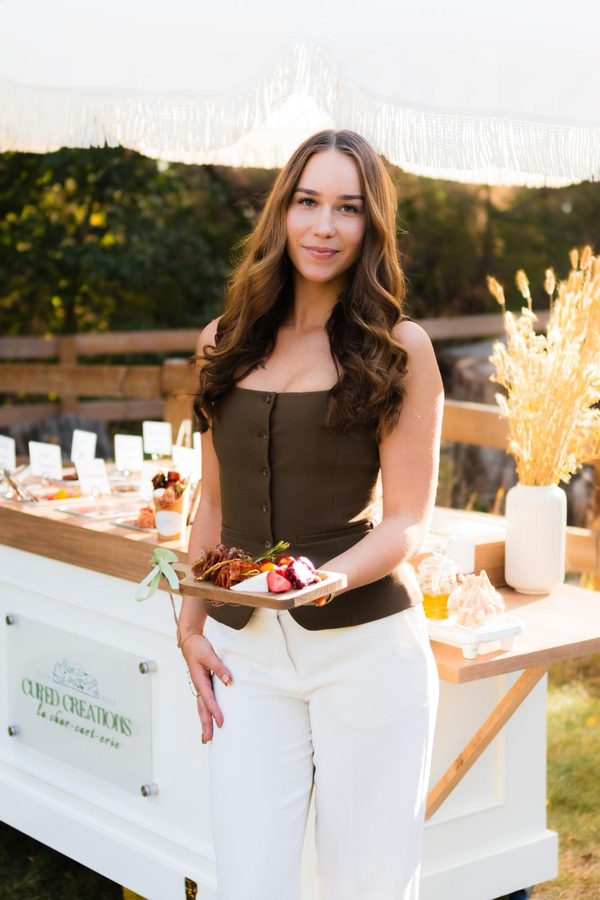
Sarah Jean
Founder of Cured Creations YEG. Restaurant-trained charcuterie artisan based in Edmonton. I build hand-styled grazing stations for weddings, corporate events, and private celebrations across Edmonton, Sherwood Park, and St. Albert.